Saturday, 30 April 2016
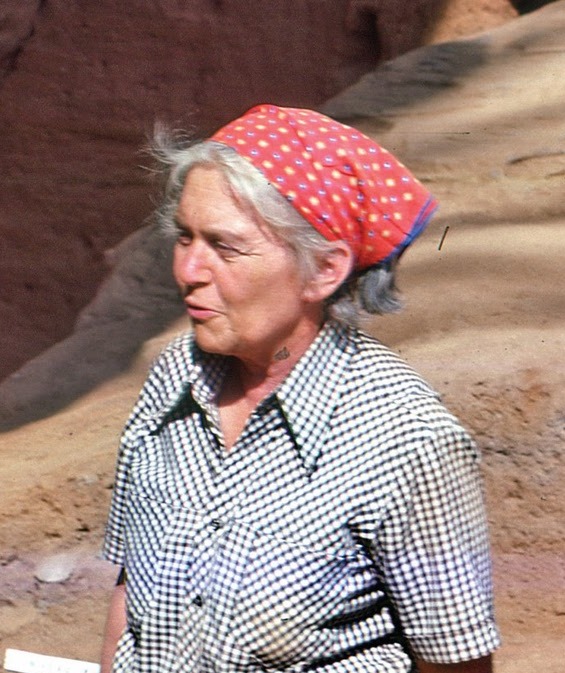
Trowelblazers - Annette Laming Emperaire
This was a French archaeologist, who also joined the French Resistance during the Second World War. She specialised in cave art, and her techniques for recording the art are still in use today.
"It involves compiling minutely detailed inventories and diagrams of the way that species are grouped on the cave walls; of their gender, frequency, and position; and of their relation to the signs and handprints that often appear close to them." (from an article in The New Yorker by Judith Thurman in 2008).
She married Joseph Emperaire, also an archaeologist, who believed that early humans had come from South Asia to South America, and gradually worked their way up into North America, rather than the "ice bridge" theory that early humans came into America across the Bering Straits in the North. They dug several sites in South America, but Joseph died when a wall collapsed on him at a dig in Chile.
In the 1970s, Annette returned to South America, digging in Brazil, where she discovered the oldest human fossil known from Brazil, at around 11,000 years old.
In 1977, she died of asphyxiation in a shower with a defective gas heating element.
Thursday, 28 April 2016
Women Warriors - West Point
I saw this picture on Twitter this morning. It's this year's black female graduates of West Point Military Academy. I must say, I love the way that a sword is still part of the dress uniform!
Monday, 25 April 2016
Doctor Who and the Peterloo Massacre
Just out from Big Finish is a 5th Doctor story by Paul Magrs, set in Manchester in 1819, the time of the Peterloo Massacre.
This is part of my local history - I'm from Manchester, and I remember being taken to see the plaque commemorating the 15 dead of the massacre (and the 600+ injured), at St Peter's Field when I was a child.
Historical stories are so often set around London, but other cities have interesting histories too, and this was an important event in working class history and Manchester's history. The peaceful crowd of around 80,000 had gathered to hear speeches against the Corn Laws - they wanted cheaper bread, and they also wanted to be able to vote. Manchester was growing rapidly with industrialisation, any yet had no MP. There were only two MPs for the whole of Lancashire, and only (male) property owners could vote.
After the reading of the Riot Act (which nobody heard) the local Yeomanry charged into the crowd on horseback, sabres drawn - and later cannons were used against the unarmed crowd. The regular Hussars, also in attendance, were horrified by the actions of the Yeomanry, and some officers tried to restrain the Yeomanry, while the way to Peter Street was blocked by infantry with bayonets, so the crowd could not escape - an early version of "kettling".
This was also one of the first mass meetings that journalists attended, and the Doctor has a great rant at Thomas Tyler, the journalist from London, urging him to tell the truth about what he has seen.
Peter Davison is in great form in this retelling of the story of the Massacre, and so are Tegan (snarling about the injustice of it all) and Nyssa (befriending a maidservant who is involved with the Radicals). Of course, they cannot stop the massacre from happening - it's a fixed point in time ("You always say that," grumbles Tegan) but they can do something to help, out of the historical spotlight.
The other actors, playing the historical characters, have properly Northern accents - there's a little extra at the end where they talk about the story and the director says he didn't want actors with RP accents pretending to be Northern.
"I was surprised there were no aliens in this one," Peter Davison says, at the end.
"Except you and Nyssa," Janet Fielding says.
"Oh, good point."
This is part of my local history - I'm from Manchester, and I remember being taken to see the plaque commemorating the 15 dead of the massacre (and the 600+ injured), at St Peter's Field when I was a child.
Historical stories are so often set around London, but other cities have interesting histories too, and this was an important event in working class history and Manchester's history. The peaceful crowd of around 80,000 had gathered to hear speeches against the Corn Laws - they wanted cheaper bread, and they also wanted to be able to vote. Manchester was growing rapidly with industrialisation, any yet had no MP. There were only two MPs for the whole of Lancashire, and only (male) property owners could vote.
After the reading of the Riot Act (which nobody heard) the local Yeomanry charged into the crowd on horseback, sabres drawn - and later cannons were used against the unarmed crowd. The regular Hussars, also in attendance, were horrified by the actions of the Yeomanry, and some officers tried to restrain the Yeomanry, while the way to Peter Street was blocked by infantry with bayonets, so the crowd could not escape - an early version of "kettling".
This was also one of the first mass meetings that journalists attended, and the Doctor has a great rant at Thomas Tyler, the journalist from London, urging him to tell the truth about what he has seen.
Peter Davison is in great form in this retelling of the story of the Massacre, and so are Tegan (snarling about the injustice of it all) and Nyssa (befriending a maidservant who is involved with the Radicals). Of course, they cannot stop the massacre from happening - it's a fixed point in time ("You always say that," grumbles Tegan) but they can do something to help, out of the historical spotlight.
The other actors, playing the historical characters, have properly Northern accents - there's a little extra at the end where they talk about the story and the director says he didn't want actors with RP accents pretending to be Northern.
"I was surprised there were no aliens in this one," Peter Davison says, at the end.
"Except you and Nyssa," Janet Fielding says.
"Oh, good point."
Saturday, 23 April 2016
Chinese Victorians - Dr Wong Fun
Wong Fun (also called Huang Kuan) was the first Chinese student to graduate from Edinburgh University. He may have been the first Chinese student to graduate from any European University. He graduated as an MD in 1855. A plaque commemorates him in Buccleuch Place in Edinburgh.
Most Chinese coming to Britain in the nineteenth century came as seamen. Some of them stayed, mostly in port cities like London and Liverpool, opening restaurants and laundries (and that one opium den in Limehouse that all the newspaper reporters in search of a sensational story went to!).
Thursday, 21 April 2016
Royalties!
I'm ridiculously pleased to have recieved an email from Smashwords, telling me that I have earned the grand total of $10.90 from my novels!
Wow! What should I do with this windfall? :)
Actually, I'm just ridiculously pleased that someone out there has read my work (and presumably enjoyed the sample enough to buy the full story)!
Wow! What should I do with this windfall? :)
Actually, I'm just ridiculously pleased that someone out there has read my work (and presumably enjoyed the sample enough to buy the full story)!
Monday, 18 April 2016
Trowelblazers - Honor Frost
Here's Honor Frost at Bodrum Harbour, with the Crusader castle in the background. She was born in 1917, and became a pioneer of underwater archaeology. The castle at Bodrum is also the home of the Underwater Archaeology Museum in Turkey, with some spectacular finds preserved there.
She started her career as a ballet designer with Ballet Rambert, but fell in love with diving in the 1940s, when she met the archaeologist Frederic Dumas, who became her mentor and took her on her first dive, to a Roman ship off the coast of France. She later joined Kathleen Kenyon at Jericho as a draughtsman - having studied at the Central School of Art in London and the Ruskin School of Art in Oxford. Having seen how digs on land were conducted, she considered how those techniques could be adapted for work underwater. She explored the harbours of Byblos, Sidon and Tyre for the Institut Francais Archaeologie in Beirut.
In 1960 she put her techniques to use on a Bronze Age Phoenecian ship off the coast of Turkey, with George Bass and Peter Throckmorton. She also worked in Alexandria, on the Pharos and palace of Alexander and Ptolemy, and other wrecks around the Mediterranean.
She helped found the Council for Nautical Archaeology and was on the Council for Nautical Research.
She died in 2010, leaving her art collection to be sold to fund the Honor Frost Foundation, which continues her work in the field of underwater archaeology.
Thursday, 14 April 2016
Goodbye, Blake - Who Will Lead the Resistance Now?
Sad to hear that Gareth Thomas has just died, aged 71. Here he is in one of his most famous roles, as Roj Blake in Blake's Seven. I remember trying to watch this on a tiny portable TV with appalling reception at college, with one person holding the wire to the ariel up to get the signal for the whole episode! Of course, he was rather outshone by Avon (Paul Darrow) who had the best snarky lines!
He was also in a couple of other cult classics of the 1970s and 80s - in Children of the Stones, he was the sensible dad who had just moved into Avebury, which was not a normal village by any stretch of the imagination.
After Blake's Seven he was, again, the dad - and Welsh resistance leader - in Knights of God, which was also the last role for Patrick Troughton, as Arthur, mystical leader of the resistance against John Woodvine's evil (and increasingly bonkers) Prior Mordrin.
He even had a guest role in Torchwood, more recently, in the episode Ghost Machine.
I understand that there is a Blake's Seven audio series from Big Finish where he also played Blake, as well as appearing as various characters in Doctor Who audio adventures.
Looking down the list of his credits on Wikipedia, he appeared in quite a few things I remember watching, like the Civil War drama By the Sword Divided. He was also in the TV adaptation of the childrens books by Jenny Nimmo, Emlyn's Moon and the Chestnut Soldier, which drew on Welsh legends for the fantasy element. The first book in the series is the Snow Spider.
Subscribe to:
Posts (Atom)


